
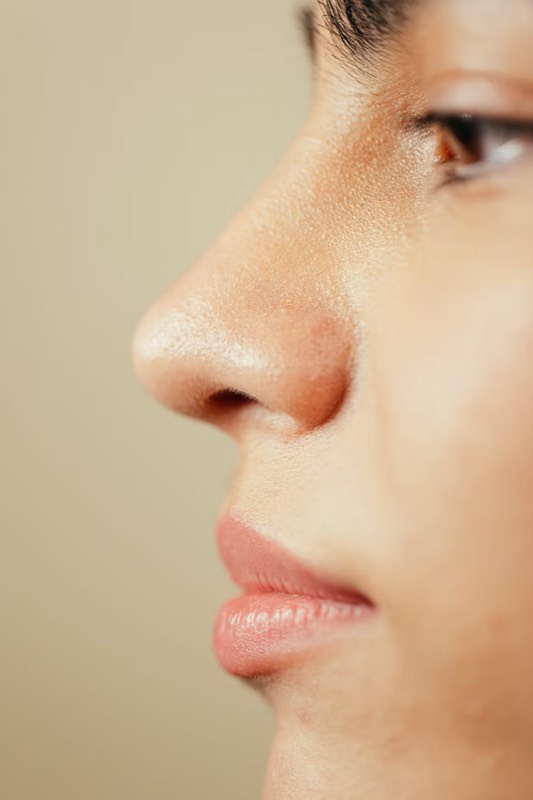
Rhinoplasty is an operation that addresses the appearance of the nose and, when needed, its breathing function at the same time. Your facial proportions, skin thickness, and cartilage and bone structure determine the plan. The goal is a natural result that is in harmony with your face.
Types of rhinoplasty
Primary rhinoplasty
Surgery for people who have not had nose surgery before. The bridge, tip and nostrils are reshaped according to facial proportions. An open or closed technique is chosen based on the structure of the nose and the planned correction.
Revision (secondary) rhinoplasty
Performed when problems with shape or breathing continue, or a new problem develops, after previous nose surgery. It is more complex than the first operation; in some cases extra tissue such as a cartilage graft may be needed. A detailed examination and information about the previous surgery are important for planning.
Septoplasty and breathing
A deviated septum or enlarged turbinates can block the nose. Septoplasty straightens the septum; when combined with aesthetic correction it is called septorhinoplasty. The aim is to improve both appearance and breathing together.
Rhinoplasty for ethnic nose types
Features such as thick skin, a drooping tip or wide nostrils affect planning. In these noses, the aim is a balanced result that preserves the person’s facial characteristics.
Cleft lip nasal deformity
Correction of the nasal shape and tip–columella problems caused by a congenital cleft lip and palate. Experience in reconstructive surgery is important in planning these operations.
Can rhinoplasty be done on thick-skinned noses?
Yes. However, skin thickness is one of the most important factors affecting the result of rhinoplasty.
Thin skin can show even small changes in the cartilage underneath. Thick skin, on the other hand, can limit how much fine detail shows, especially at the tip, and can make swelling last longer.
In thick-skinned patients it is therefore important that the tip has enough structural support and that expectations are set according to the skin.
The aim of rhinoplasty is not to copy a nose from a photo onto another person, but to achieve the most balanced result that the person’s own anatomy allows.
Recovery after rhinoplasty
After surgery there is usually a protective splint on the nose. The splint is mostly removed about one week after the operation.
Swelling of the nose and surrounding area is normal in the first days. Some patients have bruising around the eyes. Most of the bruising usually fades noticeably within the first one to two weeks.
Most patients can return to daily life within about a week. However, strenuous physical activity and sports in which the nose could be hit require a longer wait.
Swelling of the nose does not disappear all at once after rhinoplasty. Swelling at the tip in particular can take months to go down.
Although the general shape of the nose starts to show within the first few months, full healing of the tissues and the final shape of the tip take about a year in most patients, and longer in some thick-skinned or revision patients.
For this reason, it is not right to judge the result of rhinoplasty early on.
What should I pay attention to after surgery?
Keeping the head slightly raised in the first days after surgery can help reduce swelling. Care should be taken to avoid any knock to the nose.
The timing for wearing glasses, sports, swimming in the sea or a pool and other physical activities can vary with the operation performed. It is therefore important to follow the advice you are given after surgery.
Nasal cleaning, medication and, if needed, taping of the nose are also planned according to each patient’s operation.
When will I look normal after rhinoplasty?
This is one of the questions patients ask most often.
After the splint is removed, the nose usually looks swollen. Swelling on the bridge and at the tip in particular is normal.
Within the first few weeks the swelling goes down quickly and the nose starts to look more natural. Even so, the final result of the operation has not appeared yet at this stage.
In general, most of the change in the nose is seen within the first few months. The resolution of finer swelling, and the tip taking its final shape in particular, continue for months.
Rhinoplasty can therefore be thought of as an operation that “heals in a week but matures over about a year”.
Does rhinoplasty leave a scar?
In closed rhinoplasty all incisions are inside the nose.
In open rhinoplasty there is a small incision on the columella, the strip of skin between the nostrils. When closed properly, this incision usually becomes less noticeable over time.
Because wound healing differs from person to person, no surgical incision can be guaranteed to heal without a trace.
What are the risks of rhinoplasty?
As with any surgical procedure, rhinoplasty carries certain risks.
Bleeding, infection, wound healing problems, asymmetry of the nose, swelling that lasts longer than expected, changes in sensation or breathing problems can occur. Depending on how the nasal bones and cartilage heal, small irregularities or changes in shape can develop over time.
In some patients, minor corrections may be needed even though the overall result is good. If more significant problems develop, a second operation may be needed.
Because both the patient’s anatomy and the biology of healing affect the result of rhinoplasty, a completely flawless or mathematically symmetrical result cannot be guaranteed.
What is revision rhinoplasty?
A second or later nose operation in a patient who has had nose surgery before is called revision rhinoplasty.
Revision operations can range from correcting a small irregularity to restructuring most of the nose.
Because part of the nasal cartilage may have been removed in the previous operation, some revision patients need extra cartilage to rebuild support.
This cartilage can be taken from the septum or, if septal cartilage is insufficient, from the ear or rib.
In addition, scar tissue in previously operated tissues can mean that revision rhinoplasty needs different planning from primary rhinoplasty.
Rhinoplasty in men
In male rhinoplasty, too, the basic principle is to create a natural nose that suits the face.
However, because there are anatomical and aesthetic differences between male and female faces, it is not appropriate to apply the same nasal shape to every patient.
In male patients, completely flattening the bridge, raising the tip too much or making the nose much smaller than needed can create a look that does not fit the character of the face.
The surgical plan should therefore be personalized according to the patient’s facial structure, nasal anatomy and expectations.
Ethnic rhinoplasty
Patients of different ethnic backgrounds can have important anatomical differences in nasal bone, cartilage structure, nasal base and skin thickness.
The aim of ethnic rhinoplasty is not to remove a person’s characteristic facial features.
In planning, the aim is to correct imbalances in the nose and achieve a look more in harmony with the face, while preserving the person’s facial features.
Is the result of rhinoplasty permanent?
Most of the changes made to bone and cartilage in rhinoplasty are permanent.
However, the human face and nasal tissues are not entirely independent of aging. Natural changes can occur in the skin, connective tissue and cartilage over the years.
With a well-supported nasal structure, the aim is to preserve the shape achieved by surgery for many years.
When is the right time for rhinoplasty?
There is no particular season required for rhinoplasty. The operation can be performed at different times of the year.
What really matters is choosing a suitable time when you can rest during the first days after surgery and keep to your follow-up appointments.
For patients who do a lot of sport, have travel plans or need to return to social life soon after surgery, the timing can be planned individually.
What do we discuss at the consultation?
At a rhinoplasty consultation we are not only looking for an answer to the question “how should we change your nose?”
We assess together the current anatomy of your nose, your breathing, your facial proportions and the features that bother you. Then we discuss the changes that can be made and the anatomical limits of those changes.
For me, the main aim of rhinoplasty planning is not to create a nose that looks beautiful on its own, but to achieve a nose that suits your face, looks natural and keeps its function.
The information on this page is for general information only and does not replace an examination, diagnosis or treatment decision. Every patient is different and results vary from person to person. The decision to have surgery is made together, after an examination.
Would you like to talk about rhinoplasty?
If you are considering rhinoplasty, the first step is a detailed consultation. During the consultation, your nasal structure, facial proportions, breathing and expectations are assessed together, and a surgical plan suited to you is created.