
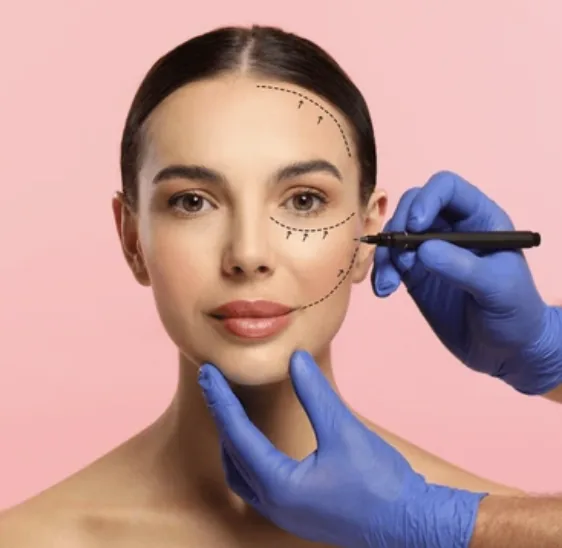
A facelift is an operation that corrects the sagging of the cheeks, jawline and neck that comes with age, by also repositioning the supporting tissues beneath the skin. The aim is not to change the structure or expression of the face, but to move the tissues to a more rested position. A facelift does not stop aging; however, it can correct a significant part of existing sagging.
Why do the tissues of the face and neck loosen?
With age, collagen and elastic fibers in the skin decrease, the fat compartments of the face shift and lose volume, and the ligaments that hold the tissues in place loosen. Gravity, sun, smoking, weight changes and genetics can speed up this process.
As a result, the cheeks descend, the lines between the nose and mouth deepen, jowls form along the jawline and laxity of the neck becomes noticeable. These changes take place not only in the skin but also in the layers beneath it.
Who is it suitable for?
People with marked sagging of the cheeks, jawline and neck, good general health and realistic expectations can be assessed for a facelift. The operation is not tied to a particular age; the decision is based on the changes in the tissues.
For people who only have fine wrinkles, skin spots or mild volume loss, a facelift may not be the first option. A facelift can be planned together with procedures such as a neck lift, eyelid surgery, a brow lift or facial fat grafting.
Assessment before surgery
At the examination, the location and degree of sagging in your face and neck, skin quality, facial skeleton, volume loss and differences between the two sides are assessed. Your blood pressure, blood-thinning medications, herbal supplements, previous operations and general health are asked about in detail.
High blood pressure is an important factor that increases the risk of bleeding after surgery and must be under control before the operation. Medications with a blood-thinning effect and some supplements may need to be stopped before surgery, in consultation with your doctor.
Skin quality and the effect of smoking
The result of a facelift is not determined by surgical technique alone. The thickness, elasticity, sun damage and overall quality of the skin affect how the result will look and how long it will last. A facelift on its own does not correct skin surface quality, fine wrinkles or spots; these may need separate skin care or other treatments.
Smoking impairs the skin’s blood supply and clearly increases the risk of wound healing problems and skin loss. Smoking and nicotine products must therefore be stopped for a certain period before and after surgery; this period will be given to you at the consultation.
The general idea behind SMAS-based approaches
Beneath the skin there is a supporting layer called the SMAS, which covers the facial muscles and carries the fat of the face. In facelift surgery today, the aim is not just to pull the skin but also to reposition this layer. This puts the load on the deep tissues rather than the skin; the approach aims for both a more natural look and a longer-lasting correction.
There are different techniques in which the SMAS layer is folded, partly removed, or released from beneath and moved upwards. Which approach is used is chosen according to your facial structure, the degree of sagging and your tissues.
How is the operation performed?
The incision usually starts in the temple, inside the hair or along the hairline, follows the natural creases in front of the ear, goes around the earlobe and extends behind the ear and, if needed, into the hair. This placement aims to make the scars less noticeable over time among the natural lines of the hair and the area around the ear.
The skin is lifted, the underlying SMAS layer is repositioned, excess skin is removed without tension, and the incisions are closed carefully. Procedures for neck laxity can be done in the same operation, if needed through a short incision under the chin. Depending on the scope of the operation, a drain may be used for a short time.
Anesthesia and hospital stay
A facelift is usually performed under general anesthesia; in some cases local anesthesia with sedation can also be used. Patients mostly stay in hospital for one night; the length of stay is planned according to the scope of the operation and your general condition.
Recovery: swelling and bruising
In the first days after surgery there is swelling, bruising and a feeling of tightness in the face and neck. Swelling is most marked in the first days and then gradually goes down. Most bruising clears within two to three weeks. Temporary numbness around the ears and cheeks is common and usually improves over months.
It is important to sleep with your head raised, rest in the first days, avoid heavy lifting and bending forward, and avoid situations that raise your blood pressure. Many people can return to social life within two to three weeks; however, it can take a few months for the tissues to soften completely and the final appearance to settle.
Risks and possible complications
The most common early complication of a facelift is blood collecting under the skin (hematoma). It mostly appears in the first hours; a large hematoma may require urgent treatment. High blood pressure and blood-thinning medications increase this risk.
Injury to branches of the facial nerve is rare. In that case, weakness of movement can occur on one side of the face; this effect is mostly temporary and improves over months, and very rarely can be permanent. The nerves that provide sensation around the ear can also be affected.
Other possible problems include infection, wound healing problems and skin loss (especially in smokers), a noticeable or wide scar, changes in the hairline and hair loss around the incision, a change in the shape of the earlobe, and asymmetry. In some cases small corrective procedures may be needed.
Frequently asked questions
How long does a facelift last?
A facelift moves the tissues to a higher position than before surgery; however, aging continues. How long the result lasts varies from person to person with factors such as skin quality, genetics, sun protection, smoking and weight changes.
Will my face look tight or different after a facelift?
The aim is not a tight or artificial look, but repositioning the tissues in a natural direction. Putting the load on the deep tissues and not over-tightening the skin are important for this. In the early period the face may feel tight because of swelling; this decreases over time.
Will the scars be visible?
Incisions are planned in places where scars are less noticeable, such as the hairline, the creases in front of the ear and behind the ear. Scars usually fade over time; however, scar quality varies from person to person and they can be seen when looked at closely.
What is a mini facelift?
This name is usually given to facelift approaches done with shorter incisions in a more limited area. It may be suitable for mild sagging; however, it may not be enough if there is marked laxity of the neck. Which approach is suitable is decided at the consultation.
Can other procedures be done with a facelift?
Yes. A neck lift, eyelid surgery, a brow lift and facial fat grafting are often planned in the same operation as a facelift. Because combinations make the operation longer, your general health is assessed alongside.
Mention all the medications you take at your consultation, including blood thinners, painkillers and herbal supplements. Some may need to be stopped before surgery, in consultation with your doctor.
The information on this page is for general information only and does not replace an examination, diagnosis or treatment decision. Every patient is different and results vary from person to person. The decision to have surgery is made together, after an examination.
Would you like more information or an appointment?
Fill in the appointment request form or call us. We will get back to you as soon as possible.