
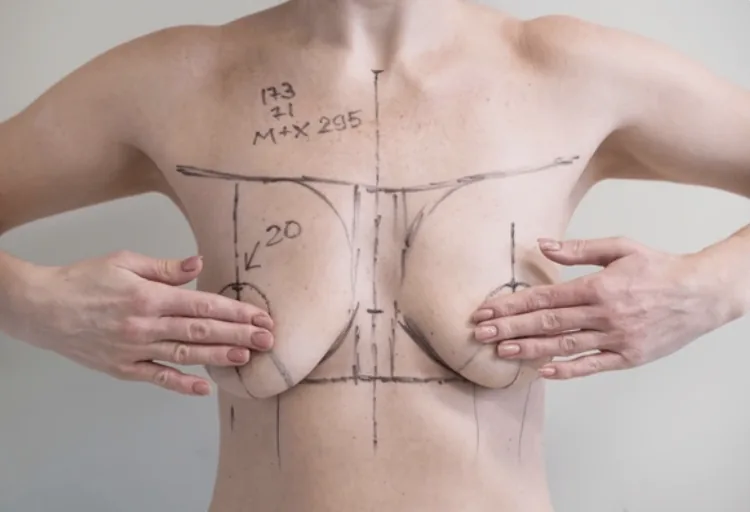
A breast lift with augmentation (augmentation mastopexy) is an operation that combines lifting a sagging breast and removing excess skin with placing an implant. It is often considered for people who have both sagging and volume loss after pregnancy, breastfeeding and weight loss. This operation aims for a correction that cannot be achieved with an implant alone or a lift alone.
Who is it suitable for?
People whose breasts have sagged and also lost volume, especially fullness in the upper part of the breast, can be assessed for this operation. A stable weight, good general health and no plans for pregnancy in the near future are important.
When is an implant alone not enough?
An implant adds volume to the breast; however, it does not tighten loose skin or move the nipple up. With mild sagging, an implant can make the breast look fuller and higher. On the other hand, if the nipple has dropped to the level of the breast fold or below, if the nipple points downwards or if the skin is clearly loose, placing an implant alone will not correct the sagging.
In such cases, using an implant alone can cause the breast tissue to slide down in front of the implant. The degree of sagging is therefore assessed carefully at the examination.
Assessment before surgery
At the examination, the degree of sagging, the position of the nipple, skin quality, the amount of breast tissue, chest measurements and the difference between the two breasts are assessed. The type, size and placement of the implant and the incision plan for the lift are decided together. Depending on your age and risk, a breast ultrasound or mammogram may be requested.
One stage or two?
In many patients, implant placement and the lift can be done in the same operation. A one-stage approach means going through recovery only once. In this operation, however, the implant tries to expand the tissue while the lift tries to tighten it. Because these two effects are balanced at the same time, planning is more delicate, and the chance of needing small corrections is higher than when each operation is done on its own.
In situations such as very marked sagging, a large difference between the two breasts, poor skin quality, changes after massive weight loss or previous breast surgery, splitting the procedures into two separate operations may be safer. In this approach the lift is usually done first; the implant is placed after the tissues have healed and settled. We decide together at your consultation which approach suits you.
How is the operation performed?
The implant is placed in the planned pocket (under the breast tissue, under the muscle or dual plane). Then excess skin is removed, the breast tissue is reshaped over the implant and the nipple is moved to its new position. Depending on the degree of sagging, the incision plan can be around the areola, vertical or inverted T; the implant is usually placed through one of these incisions.
Anesthesia and hospital stay
The operation is performed under general anesthesia. Most patients are discharged on the day of surgery or the following day; the length of stay is decided according to the scope of surgery and your general condition.
Recovery and what to pay attention to
In the first days there is tightness, swelling and bruising of the breasts. A support bra is worn for a while. Returning to desk work is usually possible within one to two weeks; heavy lifting, movements that strain the arms and strenuous sport are postponed for a few weeks.
It takes a few months for the implant to settle and the breast shape to mature. The incision scars fade over time; scar care and sun protection are important.
Risks and possible complications
This operation carries the risks of both breast augmentation and a breast lift. These include bleeding, infection, wound healing problems, a noticeable scar, asymmetry, changes in nipple sensation, rarely impaired blood supply to the nipple, capsular contracture, implant displacement and implant rupture.
With combined operations, the chance of sagging returning over time, or of needing a further corrective operation for shape and symmetry, is higher than with either operation alone. We discuss the risks specific to you in detail at the consultation.
Frequently asked questions
Will a bigger implant correct sagging?
No. A large implant does not lift sagging tissue; on the contrary, it can stretch the tissues further and increase sagging over time. If sagging is marked, a lift is needed.
In a two-stage approach, how long is the wait between operations?
Usually a few months are allowed for the tissues to heal and the breast shape to settle. The exact period is decided according to your recovery after the first operation.
Will the implant need to be replaced in the future?
Implants have no fixed expiry date, but they should not be thought of as lifetime devices either. Over time, replacement or further surgery may be needed because of the implant or changes in the breast. Regular check-ups are important.
Where will the scars be?
Depending on the lift plan used, the scars are around the areola, along the line from the areola down to the breast fold and, if needed, in the breast fold. A separate incision for the implant is usually not needed.
Can I breastfeed after this operation?
Because the nipple’s connection to the underlying tissue is preserved, many women can breastfeed. However, milk supply and nipple sensation can be affected; the ability to breastfeed cannot be predicted with certainty in advance.
Whether the lift and augmentation are done in one operation or in two stages is decided according to the examination findings. We assess this decision together at the first consultation.
The information on this page is for general information only and does not replace an examination, diagnosis or treatment decision. Every patient is different and results vary from person to person. The decision to have surgery is made together, after an examination.
Would you like more information or an appointment?
Fill in the appointment request form or call us. We will get back to you as soon as possible.