
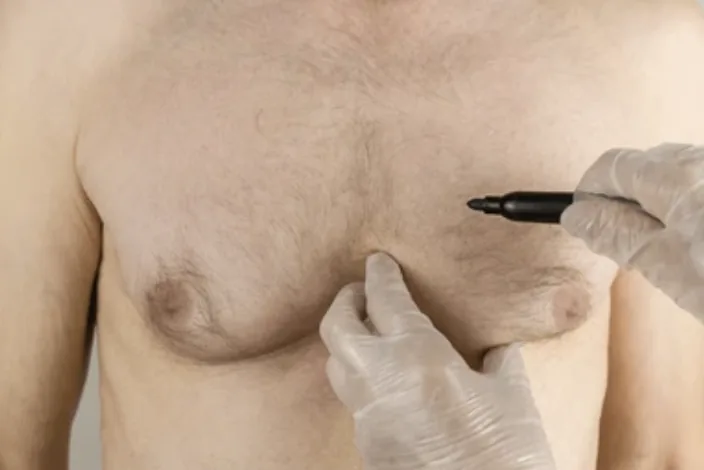
Gynecomastia is the enlargement of breast glandular tissue in men. It can be on one or both sides; it shows as fullness of the chest, puffiness around the nipple and sometimes tenderness. It can appear during puberty, in later life, with certain medications or for hormonal reasons. The treatment plan depends on the cause of the enlargement and the structure of the tissue.
True gynecomastia and enlargement due to fat
Enlargement of the male chest is not always caused by breast glandular tissue. In true gynecomastia there is firmer glandular tissue that can be felt behind the nipple. In pseudogynecomastia, the enlargement comes mostly from fat and is usually associated with excess weight. Many people have a combination of both.
This distinction matters for treatment. Fat can be reduced with liposuction; glandular tissue, however, usually cannot be removed adequately with liposuction and needs to be removed surgically.
Who is it suitable for?
Men whose chest enlargement has been assessed for its cause, whose enlargement has persisted for some time, whose weight is stable and whose general health is good can be assessed for surgery. Gynecomastia during puberty often resolves on its own; in young people it is therefore usually best to wait until puberty is complete and the enlargement has stabilized.
If there is excess weight, losing weight first can reduce chest enlargement in some people and improve the result of surgery.
Assessment before surgery
Before surgery, possible causes of gynecomastia are investigated. Anabolic steroids, some heart and blood pressure medications, some stomach medications, some medications used for prostate conditions, some psychiatric medications, alcohol and certain substances can cause breast tissue to grow. Hormonal imbalances, liver, kidney and thyroid diseases and, rarely, conditions originating in the testes are also considered.
When needed, blood tests, a breast ultrasound and assessment by related specialties (such as endocrinology and urology) may be requested. If a medication or a treatable cause is responsible for the enlargement, that cause needs to be addressed first. Lumps that are on one side only, hard, located away from the nipple, or accompanied by nipple discharge or skin changes are investigated separately.
Liposuction and gland removal
The treatment method is chosen according to the tissue. If the enlargement comes mainly from fat, liposuction is done with thin cannulas through small incisions. The glandular tissue behind the nipple is usually removed surgically through a small incision along the lower edge of the areola. In most patients both methods are used together to balance the chest contour.
Leaving an appropriate amount of tissue under the nipple is important to prevent contour problems such as the nipple sinking in and a hollow on the chest. In very large chests, and especially after massive weight loss, if there is marked excess skin it may also need to be removed, with correspondingly longer scars. The glandular tissue removed may be sent for pathological examination.
Anesthesia and hospital stay
The operation is mostly performed under general anesthesia; in limited cases local anesthesia with sedation can also be used. Most patients are discharged on the day of surgery or the following day. Some patients may have a drain for a short time.
Recovery and the compression garment
After surgery a compression vest that wraps the chest is worn. It helps reduce swelling, helps the skin adapt to the new chest contour and helps prevent fluid collection. It is usually recommended for a few weeks; the period will be explained to you separately.
In the first days there is swelling, bruising and tightness. Returning to desk work is usually possible within a few days to a week. Chest exercises, heavy lifting and strenuous sport are postponed for a few weeks. It can take a few months for the swelling to go down completely and for the chest contour to take its final form.
Risks and possible complications
Collection of blood or fluid (hematoma, seroma), infection, bruising, scarring, changes in nipple sensation and asymmetry between the two sides can occur. Rippling or irregularities can form in areas treated with liposuction. Removing too much tissue can cause a hollow under the nipple; removing too little can leave fullness.
If the cause of gynecomastia (for example, use of anabolic steroids or certain medications, or weight gain) continues, the chest tissue may grow again. In some cases small corrective procedures may be needed.
Frequently asked questions
Will gynecomastia go away with exercise and diet?
Enlargement due to fat can decrease with weight loss and exercise. However, the glandular tissue in true gynecomastia usually does not shrink with exercise and diet.
Does gynecomastia during puberty need surgery?
A large proportion of gynecomastia during puberty resolves on its own, so it is usually monitored for a while. If the enlargement becomes permanent, or causes significant complaints or psychological difficulty, surgery can be considered.
Does it come back after surgery?
The glandular tissue removed does not grow back. However, if the cause of gynecomastia continues or there is significant weight gain, the remaining tissue may grow.
Will the scar be visible?
The glandular tissue is mostly removed through an incision along the lower edge of the areola. Because this incision lies on the border where the color changes, it usually becomes less noticeable over time. Small incisions a few millimeters long are used for liposuction. Scar quality varies from person to person.
How long do I need to wear the compression vest?
It is usually recommended for a few weeks. The exact period is decided at your check-ups according to the method used and your recovery.
If you use medications, supplements or substances that can cause gynecomastia (for example, anabolic steroids), be sure to mention them at your consultation. Assessing the cause is important for a lasting result.
The information on this page is for general information only and does not replace an examination, diagnosis or treatment decision. Every patient is different and results vary from person to person. The decision to have surgery is made together, after an examination.
Would you like more information or an appointment?
Fill in the appointment request form or call us. We will get back to you as soon as possible.