
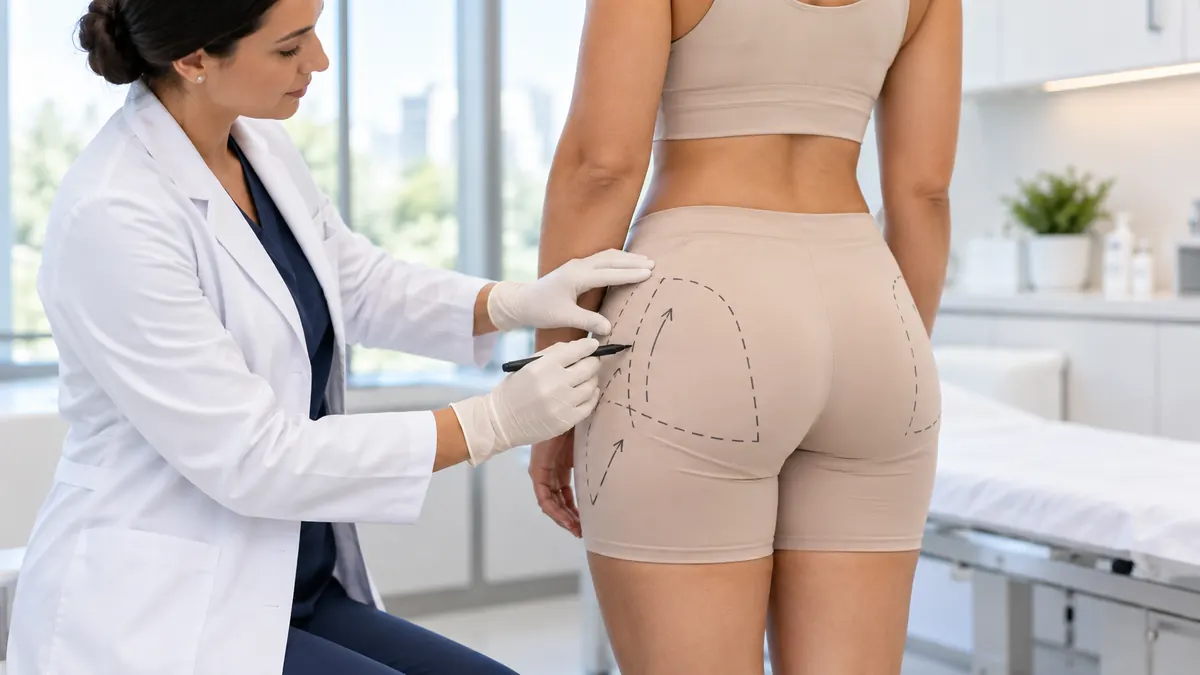
A Brazilian butt lift (BBL) is an operation that changes the volume and shape of the buttocks by removing your own fat from other areas of the body with liposuction and transferring it to the buttocks. Slimming the waist and back, where the fat is taken from, is also an important part of the result. A BBL is not a simple or routine cosmetic procedure: serious and potentially fatal complications such as fat embolism have been reported. Who it is suitable for, and the safety principles it must be performed with, therefore need careful assessment.
What is a BBL and what does it aim to do?
Although its name includes “lift”, a BBL is not a lifting operation that raises sagging buttock skin. It aims to give the buttocks volume and shape with fat grafting (taking your own fat from one area and transferring it to another). If there is marked sagging of the buttock skin, fat transfer alone will not correct it; additional procedures that remove skin may be needed.
The result depends on the balance between the volume, projection and upper fullness of the buttocks and the slimming of the waist and back. The goal is a look in harmony with the body’s overall proportions; very large volumes can both spoil a natural appearance and increase the risks.
Where is the fat taken from, and how is it prepared?
Fat is mostly taken with liposuction from areas such as the abdomen, waist, flanks, back and thighs. Slimming the areas the fat is taken from helps the buttock contour stand out more.
The fat removed is separated from the fluid, blood and fatty acids it contains and prepared for injection. Methods such as settling, filtering, washing or centrifugation can be used for this. The aim is clean fat tissue with a high chance of survival.
Waist-to-hip ratio and shaping
The perceived shape of the buttocks depends not only on their size but also on the transition between the waist, lower back and buttocks. Slimming the waist and back with liposuction changes the waist-to-hip ratio independently of the amount of fat transferred, and clearly affects the result.
BBL planning is therefore built not so much on how much fat goes into the buttocks as on how the body contours are balanced as a whole. The structure of the pelvic bones, the muscles and skin quality limit the shape that can be achieved.
Who is it suitable for?
People with good general health, enough fat to harvest, a stable weight and realistic expectations can be assessed for a BBL. Very slim people may not have enough fat to transfer. In people who are significantly overweight, the risks of surgery can increase, and losing weight first may be safer.
Any history of blood clots, heart and lung disease, conditions affecting blood clotting and smoking are assessed in detail. People who have previously had filler or an unknown substance injected into their buttocks need particularly careful assessment. At the consultation, whether the desired volume can be safely achieved is discussed openly.
General principles of fat transfer
The fat is injected through cannulas inserted via small incisions, distributed to different areas of the buttocks without creating large deposits at any one time. For the transferred fat to survive, it needs to receive nourishment from the surrounding tissue; it is therefore important to distribute it in thin layers.
The most critical safety principle is that fat is injected only into the fat layer beneath the skin (subcutaneous) and not into the muscle. This principle is explained separately below.
The risk of fat embolism
The most serious risk of a BBL is fat embolism. Within and beneath the buttock muscles are large veins that return blood to the heart and lungs. Fat injected into or beneath the muscle can damage and enter these veins and be carried to the lungs through the bloodstream. This can cause sudden respiratory and circulatory failure and death.
For this reason, international plastic surgery societies have published safety recommendations on how the operation should be performed. Following these recommendations aims to reduce the risk; however, no method can eliminate the risk of fat embolism completely.
The danger of injection into muscle, and the subcutaneous principle
In the past, there were practices in which fat was also injected into the buttock muscles to achieve more volume. Today it is known that a large proportion of serious fat embolism cases are associated with injection into or beneath the muscle. Current safety recommendations therefore state that fat should be injected only beneath the skin and never into the muscle.
Injecting fat only beneath the skin can limit the volume that can be safely transferred in one session. If more volume is wanted, planning a second stage is a safer approach than pushing the limits in a single session.
Current safety approaches and ultrasound guidance
International safety recommendations include injecting fat only beneath the skin, not angling the cannula downwards towards the muscle, using cannulas of appropriate thickness, keeping the cannula tip constantly moving and checking the cannula’s position at all times.
Using real-time ultrasound during surgery allows the surgeon to confirm with imaging that the cannula and the injected fat stay in the subcutaneous layer. This offers more objective reassurance than controlling the cannula by feel alone. Ultrasound guidance is an important measure aimed at reducing the risk; however, on its own it does not reduce the risk to zero.
Surgery, anesthesia and hospital stay
A BBL is performed under general anesthesia. The operation consists of harvesting, preparing and transferring the fat. Its length depends on the number of areas treated with liposuction and the amount to be transferred. After surgery, patients are usually monitored with an overnight hospital stay.
Combining a BBL with other operations in the same session increases the length of surgery and the risks. Such a plan is made only after a careful assessment of your general health.
After surgery: swelling, sitting and pressure
After surgery there is swelling, bruising and tenderness both in the areas where fat was taken and in the buttocks. A compression garment is applied to the areas where fat was taken. For the transferred fat to survive, it is recommended to avoid direct and prolonged pressure on the buttocks in the first weeks.
Advice on sitting, sleeping position and the use of special cushions varies between surgeons, and the scientific evidence on this is limited. The advice is therefore given to you individually according to the scope of the operation. Starting to walk early after surgery is important to reduce the risk of blood clots in the legs.
Partial absorption of fat and realistic expectations
Not all of the transferred fat survives; some of it is absorbed by the body in the first months. The amount absorbed varies from person to person and cannot be known exactly in advance. The volume immediately after surgery therefore does not show the final result; the final shape of the buttocks becomes clear over a few months.
Surviving fat behaves like the body’s other fat: it can grow with weight gain and shrink with weight loss. Some people may need a second stage to reach the desired volume. A permanent volume or a particular shape cannot be guaranteed.
Other risks and possible complications
Apart from fat embolism, firm areas and oil cysts caused by part of the transferred fat not receiving a blood supply and dying (fat necrosis), infection, fluid collection (seroma), asymmetry between the two sides, surface irregularities and more fat absorption than expected can occur.
Complications such as blood clots in the leg veins and pulmonary embolism (thromboembolism), toxicity related to the anesthetic medications, fluid balance disturbances and, rarely, irritation of the sciatic nerve have also been reported. Irregularities and changes in sensation typical of liposuction can occur in the areas where fat was taken. In some cases an additional corrective procedure may be needed.
Frequently asked questions
Is a BBL a safe operation?
A BBL is an operation for which serious and potentially fatal complications have been reported. Safety measures such as injecting fat only beneath the skin, ultrasound guidance and careful patient selection aim to reduce the risk; however, no measure eliminates it completely. These risks should be discussed in detail at the consultation.
Will injecting more fat give a better result?
No. Injecting very large volumes in a single session makes it harder for the fat to receive a blood supply, can increase the risk of fat necrosis and absorption, and is not recommended for safety reasons. If more volume is wanted, staged planning is safer.
How much of the injected fat is permanent?
Some of the transferred fat is absorbed in the first months. The amount absorbed varies from person to person and cannot be stated exactly in advance. The final result usually becomes clear over a few months.
I am very slim. Can I have a BBL?
There may not be enough fat to transfer. The amount of fat that can be harvested is assessed at the consultation; if it is not enough, the achievable change may be limited, and this is discussed openly.
When can I sit after surgery?
Avoiding direct and prolonged pressure on the buttocks is recommended in the first weeks. Advice on sitting and sleeping position is given to you individually; practice on this can vary between surgeons.
Does a BBL correct sagging buttocks?
A BBL adds volume and shape; it does not lift sagging skin. If there is marked skin sagging, fat transfer alone may not be enough, and procedures that remove skin may be considered.
If you develop sudden shortness of breath, chest pain, palpitations, a feeling of fainting or confusion in the hours and days after surgery, call 112 (the emergency number in Turkey) or go to the nearest emergency department without delay.
The information on this page is for general information only and does not replace an examination, diagnosis or treatment decision. Every patient is different and results vary from person to person. The decision to have surgery is made together, after an examination.
Would you like more information or an appointment?
Fill in the appointment request form or call us. We will get back to you as soon as possible.