
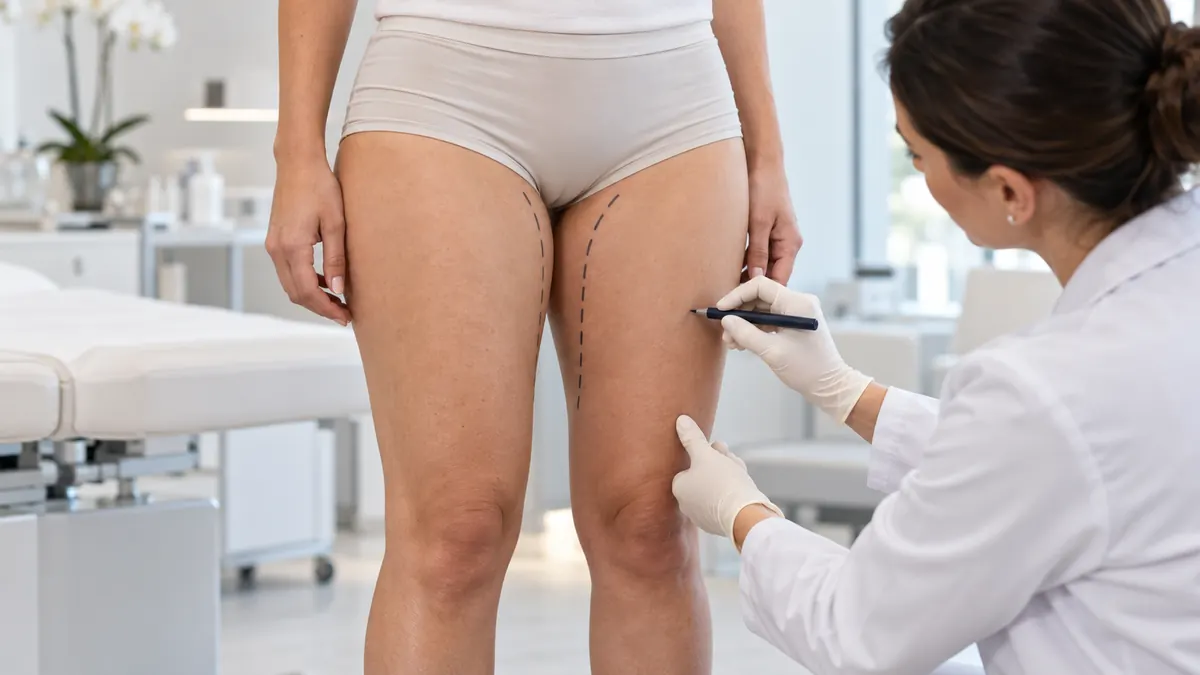
A thigh lift is an operation that tightens the inner thigh by removing sagging skin and fat. It is mostly planned for excess skin that appears after massive weight loss or with age and that can also cause chafing and skin irritation when walking. The incision site and scar length depend on how much sagging there is and in which direction.
Sagging skin on the inner thigh
The skin of the inner thigh is thin and elastic. With age, and especially after significant weight loss, this skin loosens, sags down from the groin crease and sometimes forms folds reaching down to the knee. In some people the excess is limited to the area near the groin; in others it extends along the whole thigh.
Besides the appearance, sagging skin can cause everyday problems such as chafing, sweating and redness when walking. Exercise strengthens the thigh muscles but does not tighten excess skin.
Thigh changes after weight loss
After massive weight loss, the thigh skin can loosen both vertically (sagging downwards) and horizontally (excess around the circumference). These changes are mostly seen together with laxity of the abdomen, waist and buttocks. Sagging of the outer thigh and buttocks is corrected not so much by an inner thigh lift as by operations that treat the lower body around its circumference.
For this reason, in people who have lost a lot of weight, a thigh lift is usually assessed as part of an overall plan. For details, see the body contouring after massive weight loss page.
Who is it suitable for?
People whose weight is stable, who have marked excess skin on the inner thigh, whose general health is good and who have realistic expectations about the permanent scar can be assessed for a thigh lift. If the problem is mainly fat and skin elasticity is good, liposuction alone may be enough.
At the examination, the amount and direction of excess skin, the proportion of fat, skin quality, any varicose veins or swelling (edema) in the legs and previous operations are assessed. If you have had blood clots or lymphatic problems in your legs before, you must mention it.
Medial thigh lift and the groin-crease approach
Lifting operations on the inner thigh are called medial thigh lifts. If the excess skin is limited to the upper part of the thigh near the groin, the incision can be planned along the groin crease. With this approach the scar stays in the groin crease, close to the underwear line.
In a groin-crease lift, the deep tissues are anchored to the strong connective tissue structures of the groin to prevent the suture line from drifting down over time and distorting the shape of the external genital area. However, the area that can be corrected with this approach is limited; it is not enough if the excess extends to the middle of the thigh or to the knee.
When a vertical incision is needed
If the excess skin is spread around the circumference along most of the thigh, it also needs to be removed horizontally. In that case a vertical incision is used along the inner thigh, running from the groin towards the knee. If needed, this incision is joined with the groin-crease incision.
A vertical-incision thigh lift can give a more marked correction; however, it leaves a long, permanent scar on the inner thigh that can be seen when standing. This option is planned after weighing up the balance between the scar and the correction together.
Combination with liposuction
If there is fat in addition to excess skin on the inner thigh, liposuction can be done in the same operation. Liposuction thins the tissue in the area to be removed and can help remove the excess skin more safely and in a more controlled way. In some approaches, liposuction of the skin area to be removed is done first, aiming to better preserve the underlying lymph vessels and nerves.
Scar placement
With the groin-crease approach, the scar lies along the groin line, close to the underwear line. With the vertical approach, the scar runs along the inner thigh from the groin towards the knee; it stays largely on the inside when the legs are together, but can be seen with some clothing and when moving.
Thigh lift scars are permanent. They may be red and noticeable in the first months and usually fade over time. Scars in the groin area may tend to widen or drift down because of gravity and movement.
Aftercare and movement after surgery
The operation is performed under general anesthesia; patients mostly stay in hospital for one night. After surgery a compression garment is worn and, depending on the scope, a drain may be placed. Because the groin is a moist area prone to friction, keeping the incision clean and dry is particularly important.
To reduce the risk of blood clots in the legs, short walks are started as soon as possible after surgery. At the same time, in the first weeks you need to avoid spreading the legs wide, squatting, sitting in the same position for long periods and movements that stretch the incision. Returning to desk work is usually possible after about two weeks; returning to sport is planned gradually later.
Risks and possible complications
In a thigh lift, wound healing problems can be more common, especially in the groin area and where incisions meet. Wound separation mostly heals with dressings, but it lengthens recovery. Fluid collection under the skin (seroma), blood collection (hematoma) and infection can develop.
The inner thigh contains the vessels that carry lymph from the leg. Injury to these vessels can cause a collection of lymph fluid (lymphocele) or prolonged and, rarely, permanent swelling of the leg (lymphedema). Blood clots in the leg veins and pulmonary embolism (thromboembolism) are rare but serious complications.
Other possible problems include widening or downward drift of the scar, a change in the shape of the external genital area, reduced sensation, asymmetry between the two sides and laxity returning over time. In some cases an additional corrective procedure may be needed.
Frequently asked questions
Where will the thigh lift scar be?
Depending on where the sagging is, the scar is in the groin crease, vertically along the inner thigh, or both. Which incision is needed is decided at the examination according to the amount and direction of excess skin.
Will sagging of the outer thigh and buttocks also be corrected?
An inner thigh lift does not correct sagging of the outer thigh and buttocks. These areas are mostly corrected with operations that treat the lower body around its circumference, and are planned separately.
When can I sit after surgery?
Sitting for short periods is usually possible from the first days; however, positions that spread the legs, require squatting or stretch the incision are avoided for a few weeks. Advice suited to you is given according to the scope of the operation.
Will liposuction alone be enough?
If skin elasticity is good and the problem is mainly fat, liposuction may be enough. If there is marked sagging skin, liposuction can make the sagging worse; in that case an operation that removes skin is needed.
How long does leg swelling last?
Swelling is marked in the first weeks and usually decreases over a few months. A compression garment and movement help during this period. If swelling lasts a long time or increases, it should be assessed at a follow-up visit.
The information on this page is for general information only and does not replace an examination, diagnosis or treatment decision. Every patient is different and results vary from person to person. The decision to have surgery is made together, after an examination.
Would you like more information or an appointment?
Fill in the appointment request form or call us. We will get back to you as soon as possible.