
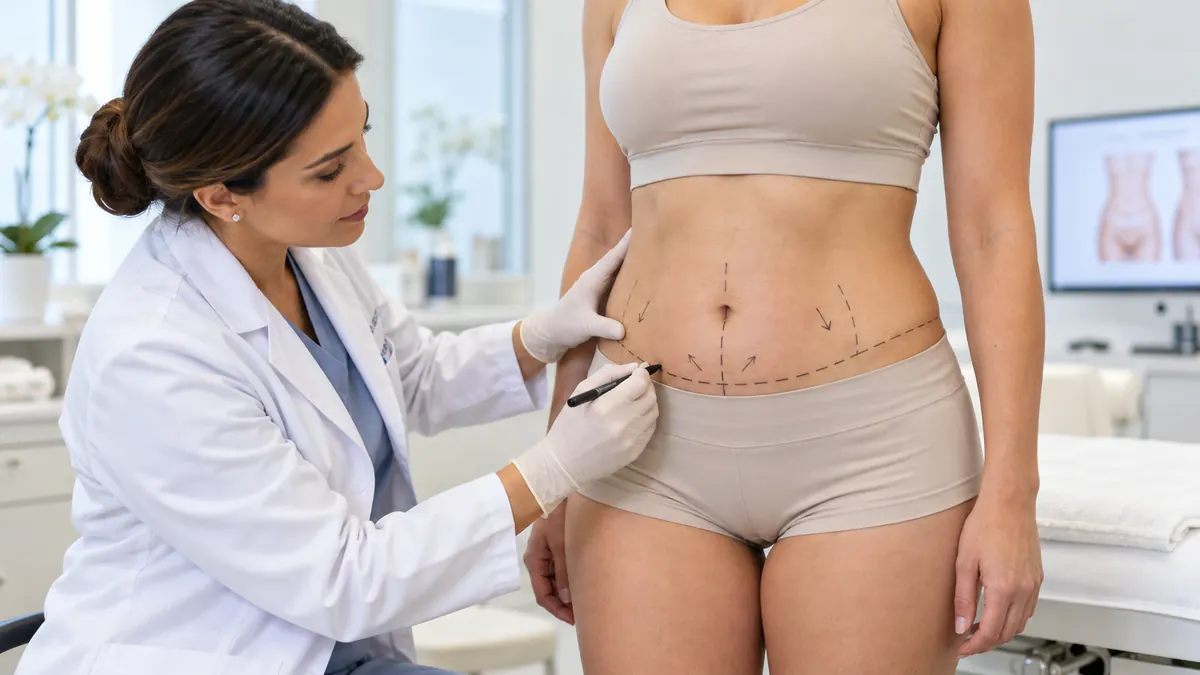
A tummy tuck (abdominoplasty) is an operation that removes the excess skin and fat that build up on the abdomen with pregnancy, weight changes and age, and, if needed, repairs loose and separated abdominal muscles. The aim is to bring the abdominal wall to a flatter, firmer position. A tummy tuck is not a weight-loss method; it is planned for people whose weight is stable and whose loose skin and muscles persist despite diet and exercise.
What problems does a tummy tuck correct?
The appearance of the abdomen is usually a combination of three components: skin that has lost its elasticity and sagged, fat beneath the skin, and laxity of the muscles in the abdominal wall. After pregnancy and significant weight loss, a skin fold on the lower abdomen, stretch marks and a forward bulge are common.
A tummy tuck can remove the excess skin below the belly button and some of the stretch marks on that skin, bring the abdominal muscles back together in the midline and help make the waistline more defined. Stretch marks above the belly button usually move downwards and do not disappear completely.
Diastasis recti and abdominal wall repair
The two rectus muscles that run vertically down the front of the abdomen are joined in the midline by connective tissue. During pregnancy, and sometimes with significant weight gain, this connective tissue stretches and the muscles move apart. This is called diastasis recti. Diastasis can cause an abdominal bulge that continues after childbirth, particularly a protrusion that increases during the day, and it does not always improve with exercise.
During a tummy tuck, the sheath covering the muscles (fascia) is stitched in the midline to bring the muscles back together. This is called plication. The examination also checks for an umbilical or abdominal wall hernia; if there is one, its repair is included in the plan, and imaging may be requested if needed.
Who is it suitable for?
People whose weight has been stable for some time, who have significant excess skin or muscle laxity on the lower abdomen, and whose general health allows surgery can be assessed for a tummy tuck. Being close to your target weight matters for maintaining the result; significant weight gain or loss after surgery can change it.
If you are thinking of a future pregnancy, it is usually better to postpone the operation until that plan is complete. Pregnancy can stretch the abdominal wall again. For people whose problem is mainly fat and whose skin elasticity is good, liposuction alone may be enough.
Assessment before surgery
At the examination, the amount and location of excess skin, the distribution of fat, the degree of muscle separation, the presence of a hernia, previous surgical scars (for example from a C-section, gallbladder or appendix operation) and skin quality are assessed. Previous incisions matter in planning because they can affect the blood supply to the abdominal skin.
Your medications, blood thinners, hormone treatments and birth control pills, any history of blood clots, diabetes and smoking are asked about in detail. This information is used to assess both the risk of healing problems and the risk of blood clots in the legs and lungs (thromboembolism). Because smoking and nicotine products clearly impair wound healing, they must be stopped before and after surgery.
The difference between a mini and a full tummy tuck
A mini tummy tuck is considered for people whose excess is limited to the area below the belly button. The incision is shorter, the belly button is not repositioned, and any muscle repair is limited to below the belly button. If there is also laxity or muscle separation above the belly button, a mini tummy tuck is not enough and may not provide the expected correction.
In a full tummy tuck, the incision extends towards the hip bones, the abdominal skin is lifted up to the edge of the ribs, the muscles are repaired above and below the belly button, and the belly button is repositioned in the new skin. If the excess extends to the sides and waist, an extended tummy tuck with a longer incision may be needed. Which approach is suitable is decided at the consultation; the aim is to provide enough correction with the shortest scar.
Fleur-de-lis tummy tuck
In a fleur-de-lis tummy tuck, a vertical incision in the midline is added to the lower horizontal incision. This allows excess to be removed both from top to bottom and from side to side. This method is mostly considered after massive weight loss, when the abdominal skin is also clearly excessive horizontally and the waist can only be narrowed this way.
The vertical incision leaves a permanent, visible scar down the middle of the abdomen; wound healing problems can be more common where the incisions meet. A fleur-de-lis tummy tuck is therefore an option decided after discussing the balance between the improvement in shape and the extra scar. For more details, see the body contouring after massive weight loss page.
Combination with liposuction
A tummy tuck can be combined in the same operation with liposuction of the waist and flanks. This can help the transition between the abdomen and waist look more harmonious. Liposuction of the part of the abdominal skin that is lifted is applied in a limited and careful way, because it can affect the skin’s blood supply.
After pregnancy and breastfeeding, a tummy tuck can also be planned together with breast surgery. These combinations are covered under the mommy makeover.
How is the operation performed?
The operation is performed under general anesthesia. An incision is made on the lower abdomen, just above the pubic hair, extending towards the hips. The abdominal skin and fat are separated from the muscle layer and lifted upwards, the muscles are repaired by stitching them in the midline, and the skin is pulled down and the excess removed.
In a full tummy tuck, the belly button is freed from the surrounding skin and left in place, then brought out through a small opening made in the newly tightened skin and reshaped. This way the belly button stays in its natural position while the skin around it changes. The length of the operation depends on the scope of the procedures and any procedures performed alongside it.
Incision placement and the scar
The incision is planned to stay within the underwear or bikini line as far as possible. At the consultation, the incision line can be marked together according to the style of clothing you prefer. The length of the scar depends on the amount of skin removed; the further the excess extends to the sides, the longer the scar. To prevent small skin bulges at the ends of the incision, the scar is sometimes planned slightly longer than first expected.
There is also a small scar around the belly button. A tummy tuck scar is permanent; it can be red and noticeable in the first months and usually fades and flattens over time. Its final appearance takes a year or longer to show and varies from person to person.
Drains and compression garments
After surgery, thin drain tubes may be used to reduce fluid collecting under the skin (seroma). Drains are removed when the amount of fluid decreases. In some approaches, the tissues under the skin are secured to the muscle layer with special stitches so that the operation can be done without drains. Whether drains are used, and for how long, depends on the scope of the operation and the surgeon’s assessment.
After surgery a garment that supports the abdomen is worn. It helps control swelling and helps the tissues adapt to their new position. It is usually worn for a few weeks, and the period will be explained to you separately.
Hospital stay and recovery
After a tummy tuck, patients usually stay in hospital for one or two nights. In the first days, walking slightly bent forward and lying with the knees slightly bent are recommended to reduce tension on the incision. Starting short walks as soon as possible after surgery is important to reduce the risk of blood clots in the legs. Depending on your clot risk, additional measures such as medication or compression stockings may be planned.
In the first weeks there is swelling, tightness and bruising of the abdomen. Numbness of the skin below the belly button is common and partly or fully recovers over months. Most people can return to desk work after two to three weeks.
Returning to daily life and exercise
Heavy lifting, movements that strain the abdomen and strenuous exercise are usually avoided for several weeks so that the muscle repair can heal. Light walking is encouraged early on. Returning to exercises that directly work the abdominal muscles and to strenuous sports is planned gradually after your recovery has been assessed at a follow-up visit.
The timing for driving, bathing, returning to work and travel will be explained to you separately according to the procedure performed and your recovery.
Risks and possible complications
A tummy tuck is a major operation and carries certain risks. The most common problem is fluid collecting under the skin (seroma); it is mostly treated by draining it with a needle and rarely recurs. Blood collection (hematoma), infection and wound separation, especially in the middle of the incision, can occur.
If part of the skin or the fat beneath it does not receive enough blood supply, tissue loss (skin or fat necrosis) can develop; this risk is higher in smokers, people with diabetes and those with previous surgical scars on the abdomen. Blood clots in the leg veins and the clot travelling to the lungs (thromboembolism) are rare but serious and potentially life-threatening complications; the risk increases with combined operations and as the length of surgery increases.
Other possible problems include a noticeable, thick or widened scar, excess skin at the ends of the scar, problems with the shape or position of the belly button, asymmetry, permanently reduced sensation and loosening of the muscle repair over time. In some cases an additional corrective procedure may be needed.
Frequently asked questions
Can I lose weight with a tummy tuck?
No. A tummy tuck is not a weight-loss method. The skin and fat removed may not make a noticeable difference on the scales. The aim is to correct the shape of the abdominal wall in people whose weight is stable.
Can I get pregnant after the operation?
Pregnancy is possible after a tummy tuck; however, pregnancy can stretch the abdominal wall and skin again, and the muscle repair can loosen. If you are planning a pregnancy, postponing the operation is therefore usually recommended.
Can I have a tummy tuck if I have a C-section scar?
Yes. In most cases the C-section scar lies within the skin to be removed or is included in the new incision line. The location of previous incisions is taken into account in planning, because it can affect the blood supply to the skin.
Will stretch marks go away completely?
Stretch marks below the belly button and within the skin that is removed are taken away with it. Stretch marks above the belly button move downwards and do not disappear. A tummy tuck does not change the surface quality of the remaining skin.
Will a mini tummy tuck be enough for me?
A mini tummy tuck is suitable for people whose excess is limited to below the belly button. If there is also laxity or muscle separation above the belly button, it may not provide enough correction. The decision is based on the examination findings.
Can an umbilical hernia be repaired in the same operation?
An umbilical hernia found at the examination or on imaging can often be repaired in the same operation. Depending on the size and structure of the hernia, joint planning with general surgery may be needed in some cases.
If you have had a blood clot before (deep vein thrombosis or pulmonary embolism), if there is a history of blood clots in your family, or if you take medication containing hormones, be sure to mention it at your consultation. This information directly affects the safety of surgery.
The information on this page is for general information only and does not replace an examination, diagnosis or treatment decision. Every patient is different and results vary from person to person. The decision to have surgery is made together, after an examination.
Would you like more information or an appointment?
Fill in the appointment request form or call us. We will get back to you as soon as possible.