
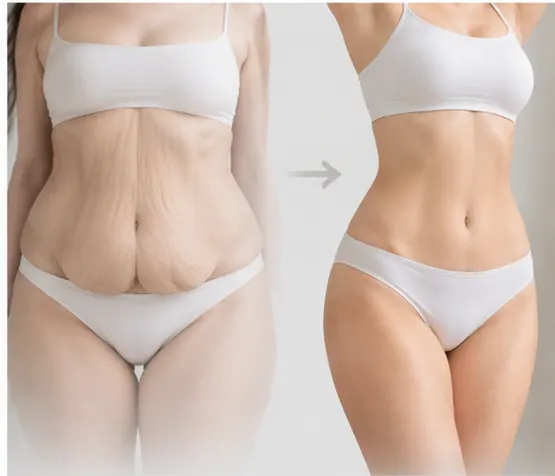
After massive weight loss, skin that has been stretched for a long time often cannot adapt to the body’s new measurements. Excess skin on the abdomen, waist, hips, thighs, arms, back and chest can cause everyday problems such as chafing, skin irritation, difficulty with hygiene and restricted movement, as well as affecting appearance. Correcting these areas usually requires a staged plan in which several operations are sequenced for each person.
Excess skin after massive weight loss
Carrying excess weight for a long time permanently affects the collagen and elastic fibers in the skin. When weight is lost, the fat decreases; but the stretched skin and the connective tissue beneath it cannot return to their former elasticity. As a result, the skin sags around the body and forms folds.
Excess skin is not limited to one area of the body. The abdomen and waist, the hips and outer thighs, the inner thighs, arms, back and chest can be affected to different degrees. Exercise and maintaining weight are important, but they do not tighten excess skin.
Body changes after bariatric surgery
After bariatric operations such as a gastric sleeve, weight loss is usually rapid and large. This rapid change puts even more strain on the skin’s ability to adapt. In addition, because these operations can affect nutrient absorption and food intake, the body’s capacity to heal wounds may also be affected.
For this reason, body contouring planning for people who have had bariatric surgery focuses not only on excess skin but also on general health and nutritional status. Staying in contact with your bariatric surgery team is helpful during this process.
Why weight stabilization matters
The best time for body contouring operations is when weight loss is complete and weight has been stable for some time. After bariatric surgery, this usually means at least 12–18 months after the operation, at a time when your weight has not changed for several months.
After operations done while still losing weight, the skin can loosen again and further correction may be needed. A stable weight helps make the result last longer and helps the body be better prepared for surgery.
Assessing nutritional status and protein deficiency
For wounds to heal, the body needs enough protein, vitamins and minerals. After massive weight loss, especially in people who have had bariatric surgery, protein deficiency can be common and can increase the risk of wound healing problems.
Before surgery, your eating habits are asked about and the necessary blood tests are requested. If a deficiency is found, nutritional support can be planned before surgery; working with a dietitian or the bariatric surgery team during this process can be helpful.
Anemia, vitamin and mineral deficiencies
After bariatric surgery, deficiencies in nutrients such as iron, vitamin B12, folic acid, vitamin D, calcium and zinc can occur. Anemia can reduce tolerance to blood loss during and after surgery and can affect healing negatively.
Before surgery, a blood count and the relevant vitamin and mineral levels are therefore assessed. Deficiencies are corrected before surgery where possible. It is important to mention all the vitamins and supplements you take at your consultation.
Lower body lift and circumferential body lift
If excess skin starts at the abdomen and extends around to the flanks, lower back and buttocks, a tummy tuck that removes only the excess at the front is not enough. In that case a lower body lift can be considered. In this operation the incision is planned to go around the waist; laxity of the abdomen, flanks, buttocks and outer thighs is treated in the same operation.
A circumferential body lift is a term for removing excess all around the waist and overlaps largely with a lower body lift. In these operations the scar goes around the waist and is planned to stay within the underwear line where possible. Because they are extensive operations, they require careful patient selection.
Fleur-de-lis tummy tuck
After massive weight loss, the abdominal skin can be markedly excessive not only from top to bottom but also from side to side. In that case a fleur-de-lis tummy tuck, with a vertical midline incision in addition to the horizontal one, can be considered. This method can be more effective at narrowing the waist; however, it leaves a permanent scar down the middle of the abdomen, and wound healing problems can be more common where the incisions meet.
Arm and thigh lift combinations
After massive weight loss, marked excess skin on the arms and inner thighs is also common. Excess on the arms often extends to the side of the chest wall and is treated with an arm lift. Excess on the inner thighs usually requires a vertical-incision thigh lift.
Sagging and volume loss of the breasts can be corrected in women with a breast lift, and excess skin and tissue on the chest in men with approaches similar to gynecomastia surgery. Upper body lift approaches can be considered for skin folds on the back.
Staged planning of operations
Correcting all areas in a single operation is often neither possible nor safe. As the length of surgery increases, the risks of blood loss, clots, infection and wound healing problems increase. Procedures are therefore usually split into several stages, with a few months between stages for the body to recover.
Which area to start with is decided together according to your complaints, your priorities and the positions the body needs to be placed in during surgery. For some people two operations are enough; others may need more stages. There is no requirement to complete this plan in a single session.
Long incisions and permanent scars
Body contouring after massive weight loss leaves long, permanent scars in exchange for removing excess skin. These scars can be around the waist, on the inner arms, on the inner thighs and, if needed, down the middle of the abdomen. The scars are planned where they can be covered by clothing as far as possible; however, it is not always possible to hide them completely.
The location and length of the scars should be discussed openly before surgery. For many people, getting rid of excess skin is seen as a greater gain than the scars; however, this is a personal judgment.
Recovery and wound complications
In people who have had massive weight loss, recovery can be longer and harder than in people who have not. Fluid collection under the skin (seroma), wound separation along the incision, infection and delayed wound healing can be more common in this group. Wound separations mostly heal with dressings, but they lengthen the process.
Drains and compression garments may be used after surgery. Starting to walk early, getting enough protein and avoiding smoking support healing. Over time, some laxity may return in the tightened skin.
Risk assessment for combined operations
Treating several areas in the same operation increases the length of surgery and the strain on the body. Before surgery, your age, weight, heart, lung and metabolic conditions, history of blood clots, nutritional status and blood test results are assessed. If needed, the opinion of other specialists is sought.
The risk of blood clots in the legs and lungs (thromboembolism) is assessed individually, and measures such as medication, compression stockings and early mobilization are planned according to this risk. Because of blood loss, a blood transfusion may rarely be needed. A combined plan is made only when it is judged appropriate from a safety point of view.
Frequently asked questions
How long after bariatric surgery can body contouring be done?
It is usually planned at least 12–18 months after bariatric surgery, at a time when your weight has been stable for several months. The exact timing depends on your weight history and general health.
Can all areas be corrected in one operation?
Most of the time this is not safe. The risks increase as the length of surgery increases. Procedures are therefore usually split into stages, with a few months between stages.
Will the scars be very noticeable?
These operations leave long, permanent scars. The scars are planned where they can be covered by clothing as far as possible and usually fade over time; however, they do not disappear. The location and length of the scars are discussed openly before surgery.
Why are blood tests requested before surgery?
After massive weight loss, deficiencies in protein, iron, vitamins and minerals can be common. Because these deficiencies can affect wound healing and the safety of surgery, they are identified and corrected before the operation where possible.
Will the skin sag again after surgery?
Some laxity may return in the tightened skin over time. Maintaining your weight helps maintain the result. Some people may need small corrective procedures.
If you have had bariatric surgery, bringing your operation report, your latest blood test results and a list of the vitamins and supplements you take to the consultation makes planning easier.
The information on this page is for general information only and does not replace an examination, diagnosis or treatment decision. Every patient is different and results vary from person to person. The decision to have surgery is made together, after an examination.
Would you like more information or an appointment?
Fill in the appointment request form or call us. We will get back to you as soon as possible.