
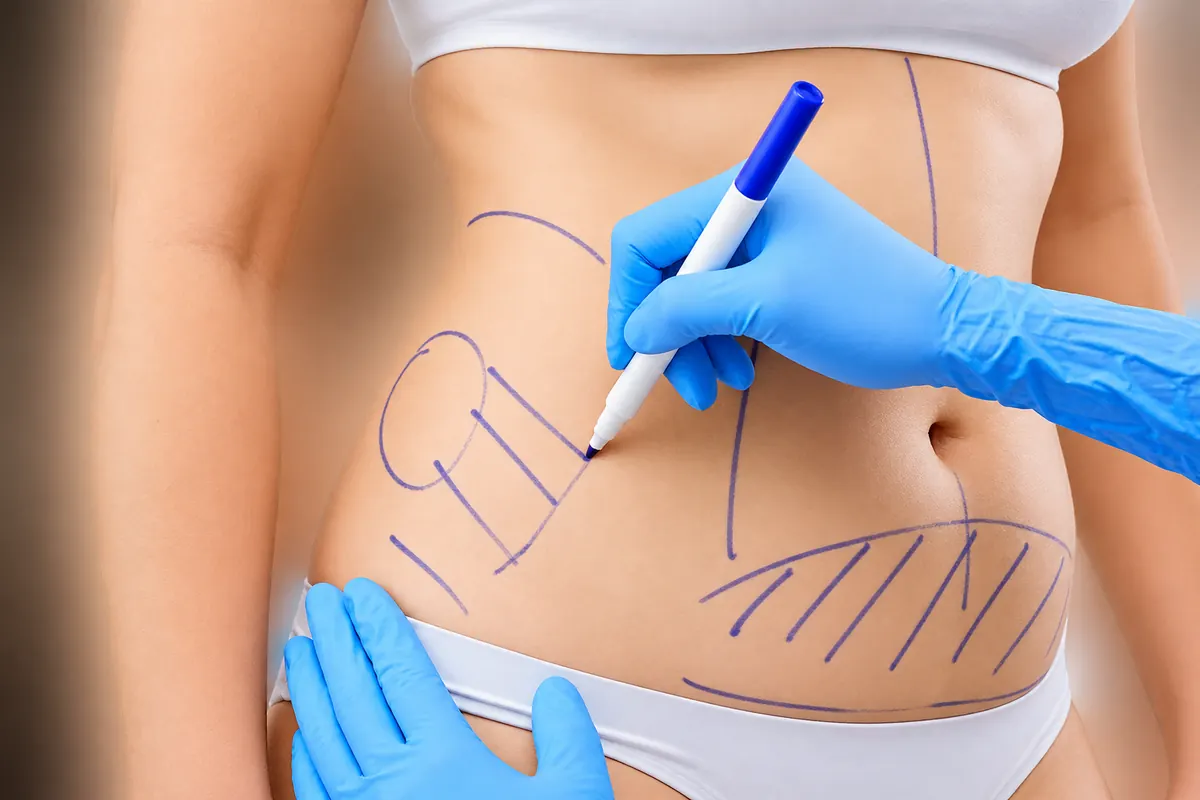
Liposuction is an operation that removes fat that has built up in certain areas of the body and does not go down despite diet and exercise, using thin cannulas inserted through small incisions. The aim is not weight loss but more balanced body contours. The result is determined not only by the amount of fat removed but also by the elasticity of the skin and the structure of the area.
What problems is liposuction suitable for?
Liposuction is used to reduce fat deposits that are out of proportion with the rest of the body in certain areas. Because of genetics and hormones, some areas can remain stubborn even after weight loss. Reducing the number of fat cells in these areas helps the body contour look smoother.
Liposuction does not correct the appearance of cellulite, does not tighten sagging skin and does not repair separated abdominal muscles. If these problems are the main concern, other procedures may be needed.
Which areas can be treated?
The abdomen, waist and flanks, back, outer hips, inner and outer thighs, inner knees, arms, under the chin and the neck are the most commonly treated areas. In men, fat on the chest can also be reduced with liposuction; if glandular breast tissue is also present, it is assessed as part of gynecomastia treatment.
Liposuction of more than one area can be done in the same session. However, the total amount of fat removed and the length of surgery are planned within safety limits; if many areas are needed, splitting the procedure into stages may be safer.
The difference between liposuction and weight loss
Liposuction is not a weight-loss method. The amount of fat removed makes a limited difference on the scales; the change shows more in measurements and body contours. The most balanced results are achieved in people whose weight is stable and close to their ideal weight.
Fat cells that are removed do not come back; however, the remaining fat cells can grow if weight is gained. Significant weight gain after surgery can lead to fat build-up in both treated and untreated areas. A balanced diet and regular activity are important for maintaining the result.
Why skin elasticity matters
When fat is reduced by liposuction, the skin needs to adapt to the new volume and tighten. This capacity of the skin varies from person to person with age, genetics, sun damage, stretch marks, pregnancies and past weight changes.
Skin with good elasticity usually adapts well to the new contour. In skin with reduced elasticity, sagging and rippling can become more noticeable after fat is removed. The examination therefore assesses not only the fat but also the quality of the skin.
The difference between liposuction and a tummy tuck
Liposuction reduces fat only. A tummy tuck removes excess skin and, if needed, repairs separated abdominal muscles. If the problem on the abdomen is mainly fat and skin elasticity is good, liposuction may be enough.
If there is sagging skin below the belly button, marked stretch marks or muscle separation after pregnancy, liposuction alone will not provide the expected correction; it can even make loose skin more visible. In some people both procedures are planned together.
Techniques used: traditional, power-assisted and ultrasound-assisted
What all liposuction techniques have in common is that fat is removed through thin cannulas with the help of suction. Before the procedure, a fluid containing medication that reduces bleeding and pain is injected into the area (tumescent fluid). The techniques differ in how the fat is loosened by the cannula.
In traditional (suction-assisted) liposuction, the cannula is moved by the surgeon’s hand. In power-assisted liposuction (PAL), the tip of the cannula makes small, rapid vibrations; this can make it easier to move through fibrous tissue, such as the back or previously operated areas. In ultrasound-assisted techniques, ultrasound energy is used to loosen the fat before it is removed.
Each technique has its advantages and limits. No technology gives superior results in every patient; the most important factors in the result are correct patient selection, careful planning and execution. The method is chosen according to the area, the tissue and the goal.
What is VASER liposuction?
VASER is the name of a device used in ultrasound-assisted liposuction. The device delivers ultrasound energy in pulses and aims to loosen fat before it is removed. It may be preferred in fibrous areas and for contouring that requires fine detail.
Because ultrasound energy is used, energy-specific risks such as heat-related skin burns and fluid collecting under the skin are taken into account. Claims that it tightens the skin more do not apply to every patient; in people with marked skin sagging, VASER does not tighten the skin either.
How is the operation performed?
Before surgery, the areas where fat will be removed and the transition zones are marked while you are standing. Depending on its scope, the procedure is performed under general anesthesia, sedation or local anesthesia. Tumescent fluid is injected through incisions a few millimeters long, and then fat is removed evenly and in a balanced way with thin cannulas.
The aim is not to remove a lot of fat from a single spot but to achieve a smooth contour in harmony with the surrounding areas. Because the incisions are small, the scars usually become less noticeable over time; incisions are placed in natural creases or areas covered by underwear wherever possible.
Anesthesia and hospital stay
With liposuction of limited areas, going home the same day is often possible. With liposuction of several areas, large-volume liposuction, or when combined with other operations, an overnight hospital stay and monitoring of fluid balance may be needed.
Compression garments, swelling and bruising after surgery
After surgery, a suitable compression garment is worn on the treated area. It helps control swelling and helps the skin adapt to the new contour. It is usually worn for a few weeks.
Some fluid leaking from the incisions in the first days is normal. Bruising usually fades within a few weeks. Swelling lasts longer; the treated areas may feel firm and slightly uneven. The final result can take a few months to appear. Depending on their work, most people return to daily life within a few days to one or two weeks; the return to strenuous exercise is planned gradually later.
Risks and possible complications
The most common problems after liposuction are contour irregularities such as surface rippling and dents, asymmetry between the two sides, and fluid collecting under the skin (seroma). Removing too much fat, or fat too close to the surface, can cause permanent irregularities. Numbness, color changes and infection can also occur.
Rarer but serious complications include blood clots in the leg veins and pulmonary embolism (thromboembolism), fat embolism, fluid balance disturbances, toxicity related to the medication in the tumescent fluid, and injury by the cannula to deeper structures such as the abdominal wall. These risks are reduced through a detailed examination, planning the amount removed within safe limits, and careful monitoring during and after surgery, but they cannot be eliminated completely.
In some cases, corrective procedures such as additional liposuction or fat grafting may be needed to correct irregularities.
Frequently asked questions
How much weight will I lose with liposuction?
Liposuction is not done to lose weight. The effect of the fat removed on the scales is limited; the change shows more in measurements and body contours. If you are significantly overweight, losing weight first may be more appropriate.
Does the fat come back?
Fat cells that are removed do not come back. However, the remaining fat cells can grow if you gain weight. Keeping your weight stable after surgery is therefore important for maintaining the result.
Is VASER better than traditional liposuction?
Each technique suits different situations. VASER can make it easier to work in some fibrous areas; however, it cannot be said to give better results in every patient, and it has its own specific risks. The method is chosen according to the area and your tissue.
Will my skin sag after liposuction?
If your skin elasticity is good, it usually adapts to the new contour. In skin with reduced elasticity, sagging can become more noticeable after fat is removed. In that case, procedures that remove skin, such as a tummy tuck, arm lift or thigh lift, may be more suitable.
How long do I need to wear the compression garment?
The period depends on the areas treated and the amount removed; it is usually a few weeks. The right period and type of garment for you will be explained after surgery.
Does liposuction get rid of cellulite?
No. Cellulite comes from the structure between the skin and the connective tissue beneath it and does not improve with liposuction. In some cases it can even look more noticeable after fat is removed.
If you develop sudden shortness of breath, chest pain, confusion, or swelling and pain in one leg in the days after surgery, call 112 (the emergency number in Turkey) or go to the nearest emergency department without delay.
The information on this page is for general information only and does not replace an examination, diagnosis or treatment decision. Every patient is different and results vary from person to person. The decision to have surgery is made together, after an examination.
Would you like more information or an appointment?
Fill in the appointment request form or call us. We will get back to you as soon as possible.